

Designer indicators for two-photon recording of subthreshold voltage dynamics
Michelle A. Land, Mario Galdamez, Vincent Villette, Jun Zhu, Xiaoyu Lu, Mate Marosi, Shuyuan Yang, Gregory Foran, Alex J. McDonald, Xiaoyu Dong, Elsayed Zaabout, Haixin Liu, Zhuohe Liu, Kevin L. Colbert, Shujuan Lai, Matthew Shorey, Anthony S. G. Lourdiane, Annick Ayon, Jonathan Bradley, Caroline Mailhes-Hamon, Ryan G. Natan, Jian Zhong, Ryan Kroeger, Robert G. Law, Noura Hakam, Cameron L. Smith, Ming Hu, Shanii Tabb, Brice Bathellier, Barna Dudok, Na Ji, Laurent Bourdieu, Jacob Reimer, François St-Pierre
15
Apr
2026
Abstract
Subthreshold voltage dynamics are essential for neuronal information integration, yet they remain technically challenging to measure in vivo. While genetically encoded voltage indicators are emerging as powerful tools for voltage recording, they lack the sensitivity to detect millivolt-scale subthreshold fluctuations with two-photon microscopy—the method of choice for deep-tissue recording. To overcome this limitation, we engineered two genetically encoded voltage indicators, JEDI3sub and JEDI3hyp, with enhanced subthreshold voltage detection under two-photon excitation. In the mouse brain, JEDI3sub enabled simultaneous tracking of subthreshold optical tuning from over 100 cells simultaneously, while JEDI3hyp captured subthreshold dynamics associated with sharp-wave ripples in hippocampal PV+ interneurons. Moreover, JEDI3hyp supported prolonged imaging of brain-state-dependent, millivolt-scale subthreshold voltage changes across deep-layer somas, fine dendritic structures and diverse cell types. By enabling sensitive reporting of subthreshold voltage dynamics, JEDI3 indicators open previously unexplored avenues for dissecting neural information processing in health and disease.
Products
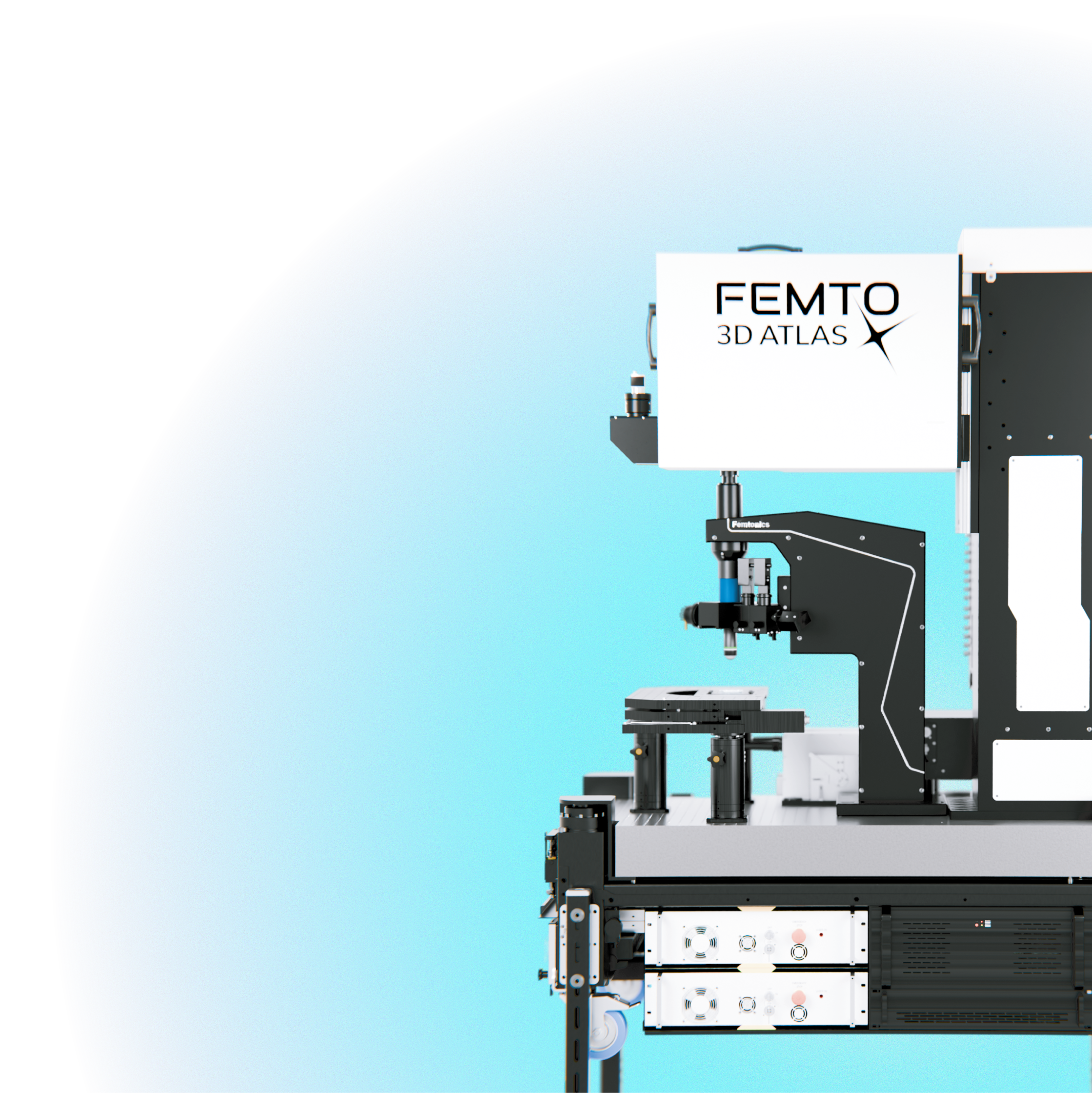
FEMTO3D Atlas Plug&Play
Full AOD performance, ready in under an hour
View SystemApplications


Acousto-Optic scanning
No moving parts. Ultrafast scanning. Acousto-optic deflectors steer the laser beam in 3D at up to 100 kHz, letting the Femto3D Atlas record signal from thousands of neurons simultaneously.